
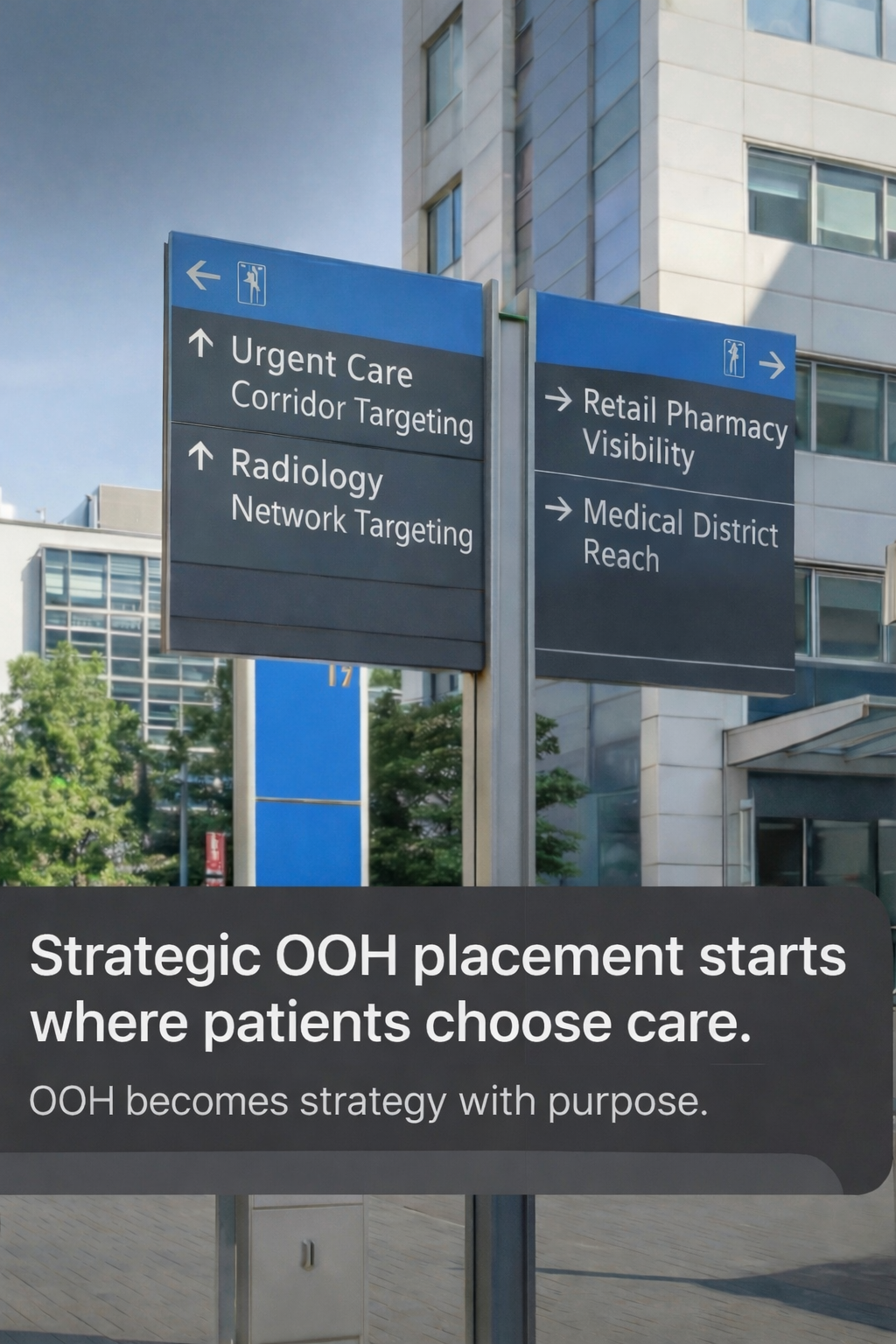
Healthcare out of home advertising has historically been purchased for broad regional awareness. Billboards, transit media, and roadside displays were commonly placed along major commuting corridors to reinforce brand familiarity across an entire metropolitan area.
That model is beginning to shift.
Health systems are increasingly positioning out of home media closer to environments where healthcare decisions actually form. Hospitals, imaging centers, urgent care corridors, and medical office districts are emerging as strategic placement zones. This shift reflects a growing recognition that proximity to decision environments can influence patient choice more directly than broad geographic visibility.
What Is Proximity Based Out of Home Media
Proximity based out of home media refers to the strategic placement of physical advertising near locations where healthcare decisions are likely to occur. Instead of focusing on general regional exposure, hospitals position billboards, digital displays, and transit media close to healthcare touchpoints such as hospital campuses, medical office clusters, and diagnostic centers.
This approach aligns media visibility with the geographic environments where patients are evaluating care options.
Why Healthcare Decisions Form in Specific Environments
Healthcare decisions rarely occur in isolation. Patients often begin evaluating care options while interacting with related services or environments. A hospital visit, an appointment with a primary care physician, or an imaging referral can trigger awareness of additional care needs.
These moments represent decision environments where patients are already thinking about health outcomes. Media exposure in these environments has a different psychological impact than general awareness advertising placed miles away from the moment of consideration.
For healthcare marketers, recognizing where these moments occur provides a more precise framework for media placement.
How Hospitals Historically Purchased Out of Home Media
Historically, hospital out of home campaigns emphasized reach and visibility across entire metropolitan regions. Billboards along highways and major transit corridors were used to reinforce brand presence and familiarity.
While this approach helped build recognition, it often lacked alignment with patient decision geography. Exposure occurred far from the places where patients were actively evaluating care options.
As hospital marketing analytics have improved, many health systems have begun examining patient origin data more closely. This analysis frequently reveals that patient volume originates from specific trade areas rather than across an entire region.
Why Proximity Placement Is Becoming More Important
When patient origin data is combined with healthcare decision environments, a different media strategy begins to emerge. Instead of distributing out of home placements evenly across a region, hospitals concentrate visibility near environments that influence patient consideration.
Examples of these environments include hospital campuses where care decisions are confirmed, urgent care corridors where immediate treatment choices occur, imaging centers where diagnostic needs become apparent, and medical office districts where referrals and specialist consultations originate.
Proximity based placement allows hospitals to reinforce their presence at moments when patients are already evaluating healthcare options.
Aligning Out of Home Media with Patient Decision Geography
Hospitals increasingly analyze geographic patterns of patient behavior to guide media placement. Service lines such as orthopedics, cardiology, maternity, and oncology often draw patients from specific neighborhoods or ZIP code clusters.
Out of home placements located within these trade areas reinforce visibility close to the patient journey. Digital displays near hospital corridors, billboards approaching medical districts, and transit media surrounding healthcare hubs can all influence how patients perceive available care options.
This alignment transforms out of home media from general brand reinforcement into a strategic component of patient acquisition.
Integrating Proximity Media with Digital Marketing
Proximity based out of home media rarely operates in isolation. Hospitals increasingly coordinate physical media placements with digital visibility strategies.
Local search marketing ensures hospitals appear when patients research symptoms or treatment options online. Social media campaigns reinforce service line messaging within the same geographic areas where out of home media is visible.
When these channels operate together, the hospital becomes visible across both physical and digital decision environments.
Coordinating Strategy Across Multi Location Health Systems
Large health systems often operate multiple hospitals and specialty centers across a region. This creates a complex media allocation challenge.
Proximity placement requires coordination across campuses to ensure each facility receives visibility aligned with its service offerings and geographic reach.
Hospitals with strong media infrastructure and disciplined allocation modeling are better equipped to manage this complexity. Organizations that treat media buying as strategic infrastructure rather than isolated campaigns are able to adjust placement decisions as patient behavior evolves.
Health systems working with experienced media partners such as DCW Media are often better positioned to implement these strategies because media allocation modeling and local market analysis are foundational to their planning process.
Key Questions Healthcare Marketing Leaders Should Consider
What is proximity based out of home media in healthcare marketing?
Proximity based out of home media refers to the strategic placement of advertising near environments where healthcare decisions occur. Instead of focusing on general regional visibility, hospitals position billboards, digital displays, and transit media close to locations such as hospital campuses, imaging centers, urgent care corridors, and medical office districts.
Why are hospitals moving out of home media closer to healthcare decision environments?
Hospitals increasingly recognize that patient decisions often form within specific geographic environments connected to healthcare activity. When media is placed near hospitals, medical offices, or diagnostic centers, it reinforces awareness at the moment patients are already thinking about care.
Strategic Implication
Out of home media has long been valued for broad visibility and brand reinforcement. In healthcare marketing, however, visibility alone is no longer sufficient. Hospitals are beginning to align media placement with the environments where patient decisions actually take shape.
As health systems refine patient origin analysis and service line growth strategies, proximity based out of home placement is becoming an important component of patient acquisition planning.
Organizations that approach media buying as strategic infrastructure rather than isolated campaigns are better positioned to adapt as patient behavior continues to evolve.
When media visibility aligns with patient decision geography, out of home advertising moves beyond awareness and becomes part of a coordinated healthcare growth strategy.
